
If you're looking for the ultimate Japanese pork belly recipe, this authentic kakuni is rich, melt-in-your-mouth tender and packed with savory-sweet flavor. Known in Japan as buta no kakuni, this classic dish slowly simmers pork belly until unbelievably tender before being caramelized under the broiler for incredible texture.
If you love comforting Japanese dishes like this, be sure to try this Shoyu Ramen too. It's another favorite example of delicious Japanese home cooking.
Whether you're new to making homemade kakuni or already love Japanese cuisine, this dish is surprisingly easy to prepare and tastes even better than restaurant versions.
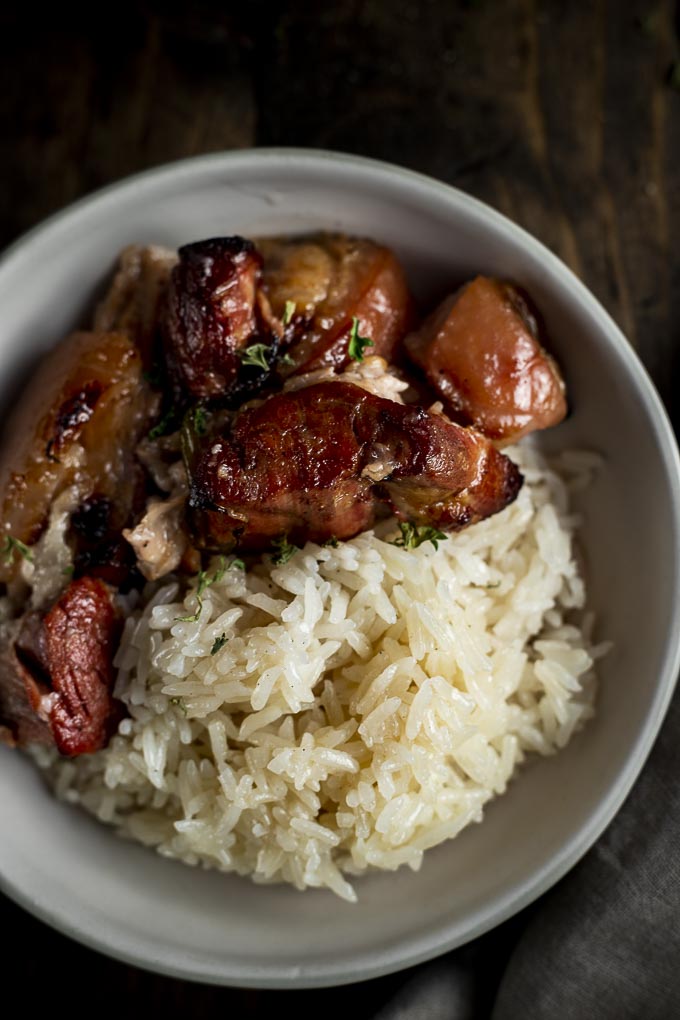
This Kakuni its SO EASY. Throwing some pork belly in a pot and letting it simmer on low for a couple hours just doesn't take that much effort.
And at the end you have a beautiful fall apart tender melt-in-your-mouth piece of pork - like with this Chinese braised pork belly or these braised pork shanks that we really love too!
Seriously, this pork just melts in your mouth. It's incredible. Serve it on top of some rice with some sliced green onions and you've got yourself a pot of gold.
These Pork Belly Tacos are another great way to indulge in pork belly, as is this Crispy Pork Belly Yakisoba, pork belly sandwich or sous vide pork belly.
Jump to:
- What is Kakuni?
- Why This Recipe Works
- Why This Kakuni is Better Than Store-Bought
- What is My Take on Japanese Comfort Food?
- Ingredients
- Key Ingredients
- Step By Step Instructions
- How to Get the Best Tender Pork Belly
- Common Mistakes to Avoid
- Variations
- What to Serve With Kakuni
- Expert Tips
- Frequently Asked Questions
- Storage + Reheating + Make Ahead + Meal Prep
- Closing Kakuni
- Recipe
- 💬 Comments
What is Kakuni?
Kakuni, also known as buta no kakuni, is a traditional Japanese braised pork belly dish made by slowly simmering chunks of pork belly in a flavorful mixture of dashi, soy sauce, sake, mirin, sugar and aromatics until incredibly tender. It is considered classic Japanese comfort food and is commonly served with rice and vegetables.
Want to Save This Recipe?
Enter your email & I'll send it to your inbox. Plus, get great new recipes from me every week!
By submitting this form, you consent to receive emails from Went Here 8 This.
Why This Recipe Works
- The pork belly is slowly simmered, creating incredibly tender pork belly every time.
- Dashi adds deep umami flavor found in traditional authentic Japanese recipes.
- Broiling at the end creates irresistible caramelized edges.
- Minimal ingredients produce maximum flavor.
- Perfect for weeknight dinners or special occasions.
Why This Kakuni is Better Than Store-Bought
Store-bought versions often lack the rich depth of flavor found in homemade versions. Making homemade kakuni allows you to control sweetness, sodium and texture while enjoying freshly caramelized pork belly straight from the oven.
Plus, nothing beats freshly prepared soy braised pork belly made in your own kitchen.
What is My Take on Japanese Comfort Food?
For me, dishes like kakuni represent the very best of Japanese comfort food. Similar to dishes like Japanese Beef Curry Udon, this recipe is hearty, deeply flavorful, and perfect for cozy evenings. I especially love serving it over steamed rice because the braising sauce soaks beautifully into every bite.
Ingredients
If you want to learn a little more about the Japanese ingredients I use in my cooking, check out this post on the Japanese Pantry Essentials.
How to Choose Pork Belly
For the best results, buy center cut pork belly, and get it as lean as you can. Pork belly has a very high fat content, and while we want the fat (it's what makes it so good!), we also want a good ratio of meat to fat, like we use in this Twice Cooked Pork.
Learn more about pork belly.
- 1 ½ pounds pork belly
- 2 cups water
- 2 ½ teaspoons dashi stock
- ½ cup mirin
- ¼ cup sake
- ¼ cup soy sauce
- 2 tablespoons sugar
- 1 inch piece of ginger peeled
- 6 green onions ends removed and cut in half
Scroll down to the recipe card for a printable version of ingredients and instructions.
Key Ingredients
- Pork Belly - The star ingredient. Choose thick, meaty pieces with a good balance of fat and meat for the best braised pork belly.
- Dashi Stock - Provides the signature umami flavor essential in traditional Japanese braised pork.
- Mirin & Sake - These classic Japanese ingredients add sweetness and complexity while helping tenderize the meat.
Step By Step Instructions
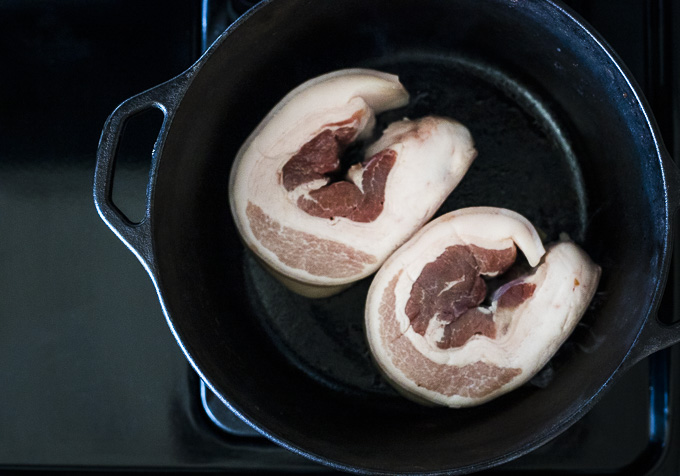
Step1: Heat a dutch oven over medium high heat and brown the pork belly on all sides.
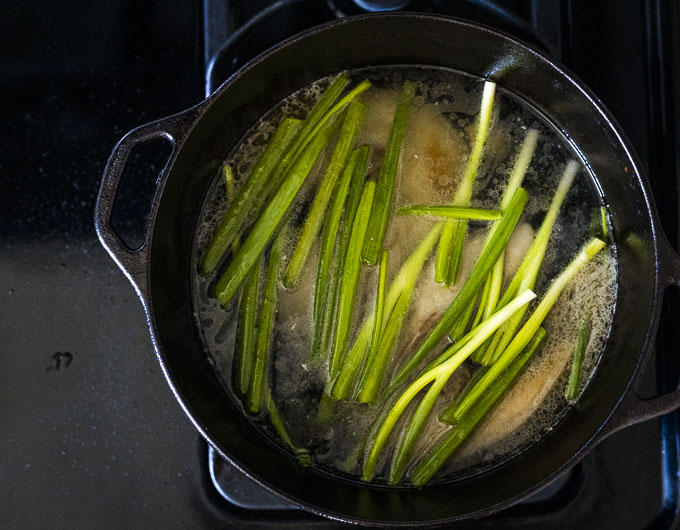
Step2: Add enough water to cover the pork belly and add the ginger and green onions. Bring to a boil, reduce heat, cover and simmer on low for 2 hours. Pork belly should be tender.
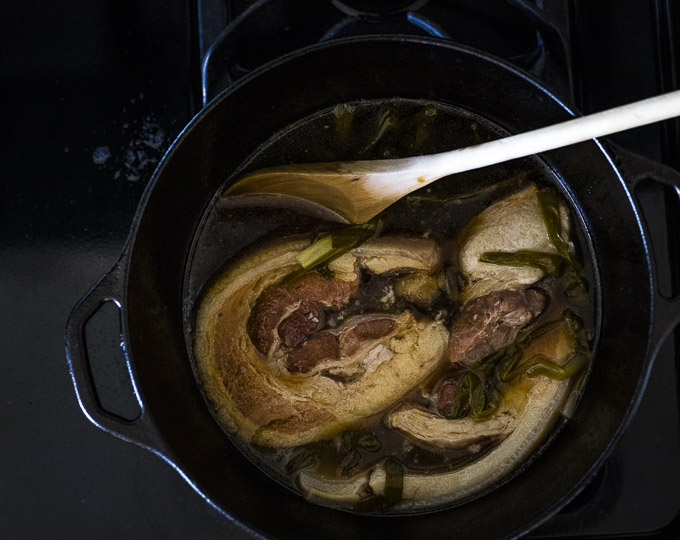
Step3: Drain the pork belly. I highly recommend saving the cooking liquid for future use.
Step4: Put remaining ingredients in a pot with pork belly and bring to a boil.
Step5: Reduce heat and simmer on low for 30 minutes, uncovered. Sauce should be reduced.
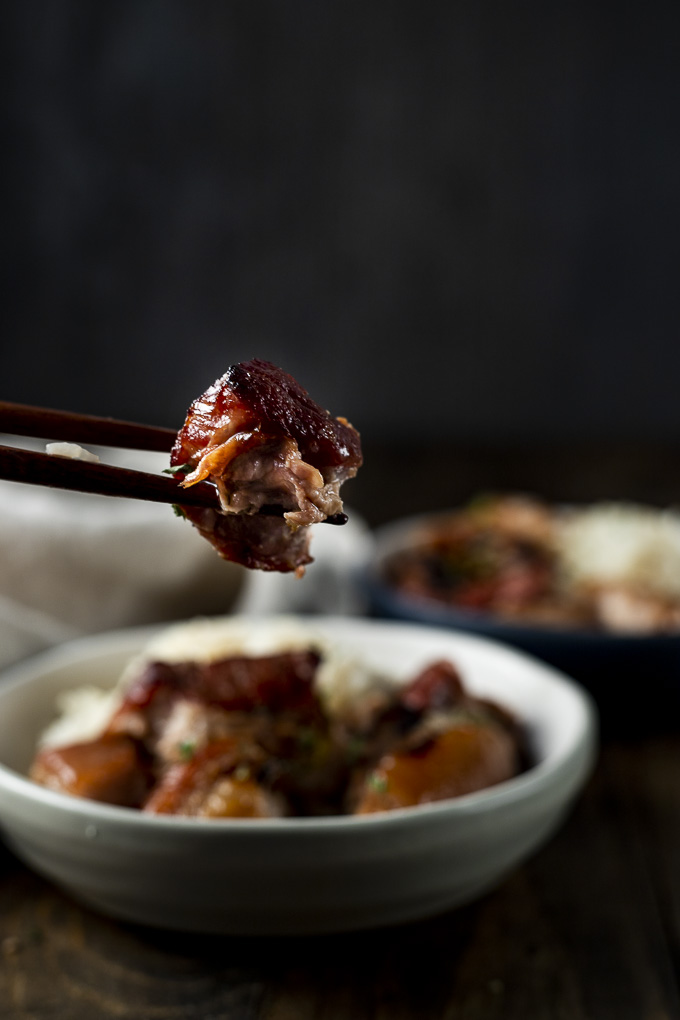
Step6: Drain and place pork belly pieces on a lined baking sheet. Broil each side for 3-5 minutes, until lightly crisped and carnalized.
Serve over Instant Pot sushi rice, in ramen or with vegetables.
How to Get the Best Tender Pork Belly
- Simmer low and slow.
- Don't rush the initial two-hour braise.
- Allow the sauce to reduce naturally.
- Broil just until caramelized to prevent drying.
Common Mistakes to Avoid
- Boiling too aggressively instead of gently simmering.
- Skipping the browning step.
- Not reducing the braising sauce sufficiently.
- Over-broiling and drying out the pork.
Variations
- Add soft boiled eggs during the final simmer.
- Serve over ramen noodles.
- Add daikon radish during braising.
- Use the leftovers in rice bowls.
What to Serve With Kakuni
This Japanese dinner recipe pairs beautifully with:
You can also serve it alongside steamed vegetables or a simple cucumber salad for a complete meal.
Expert Tips
- Place the pork belly under the broiler for 5-10 minutes to crisp up the fat. Be careful not to let it burn! It will burn quickly due to the sugar in the braising liquid.
- Buy the pork belly with the least amount of fat you can find. It will still have plenty of fat to be nice and tender.
- If you don't have sake, you can substitute a dry white wine.
- You can substitute chicken stock for the dashi, but the flavor of the dish will not be as good.
- Refrigerate overnight for even deeper flavor.
- Save the first cooking liquid for soups or ramen broth.
Frequently Asked Questions
Pork belly is typically tough when it hasn't been cooked long enough. It can also be tough if you choose a meat that is too lean and overcook it - it should have a good amount of fat on it, while still having a good amount of meat.
Kakuni is not typically spicy. Kakuni is a braised pork belly commonly used in Japanese cuisine. It has a sweet and savory taste. If you want to make it spicy, you can serve it with hot sauce or chili oil.
Kakuni is a traditional Japanese version of braised pork belly that uses dashi, sake, mirin and soy sauce to create a uniquely Japanese flavor profile.
Yes. Buta no kakuni is considered a classic authentic Japanese recipe enjoyed throughout Japan.
Pork belly is essential because its fat content creates exceptionally slow simmered pork belly with melt-in-your-mouth texture.
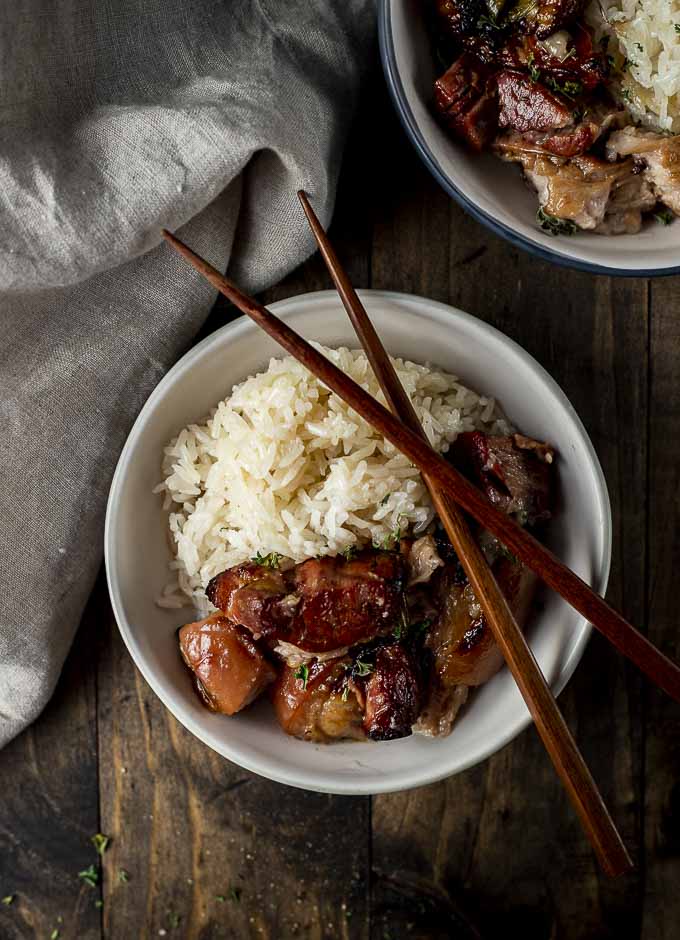
How to Use Kakuni (Ways to Eat Kakuni)
- Serve it with some steamed white rice or Fried Rice and garnish it with sliced green onions;
- Place slices of kakuni in Homemade Ramen;
- Serve it with a side of veggies like this Baby Bok Choy or pickles to cut the richness of the pork.
- Serve it on a sandwich with a Japanese mayonnaise.
If you're a pork lover like I am, you may want to also browse all the Pork Recipes - there are some ultra delicious ones on the site!
Storage + Reheating + Make Ahead + Meal Prep
- Storage - Store leftovers in an airtight container in the refrigerator for up to 4 days.
- Freezing - Leftover kakuni can be stored in the freezer (in a freezer safe bag or container) for up to 3 months. Thaw in the fridge overnight and reheat in the oven to re-crisp the skin.
- Reheating - I recommend reheating the pork belly in the oven for the best results. This will enable the skin to crisp back up. Be careful not to overcook.
- Make Ahead - Prepare the recipe one day ahead for enhanced flavor.
- Meal Prep - Portion with rice and vegetables for convenient lunches throughout the week.
Closing Kakuni
This kakuni recipe is one of my favorite examples of Japanese home cooking. Rich, savory and unbelievably tender, this Asian pork belly recipe delivers restaurant-quality flavor right at home. Whether you're exploring traditional Japanese cuisine or simply searching for a new pork belly recipe, this dish is guaranteed to impress.
Did you make this Kakuni recipe? Rate the recipe and leave me a comment to let me know how it turned out!
Recipe
Kakuni (Japanese Pork Belly)
Ingredients
- 1 ½ pounds pork belly
- 2 cups water
- 2 ½ teaspoons dashi stock
- ½ cup mirin
- ¼ cup sake
- ¼ cup soy sauce
- 2 tablespoons sugar
- 1 inch piece of ginger peeled
- 6 green onions ends removed and cut in half
Instructions
- Heat a dutch oven over medium high heat and brown the pork belly on all sides.
- Add enough water to cover the pork belly and add the ginger and green onions. Bring to a boil, reduce heat, cover and simmer on low for 2 hours. Pork belly should be tender.
- Drain the pork belly. I highly recommend saving the cooking liquid for future use.
- Put remaining ingredients in a pot with pork belly and bring to a boil.
- Reduce heat and simmer on low for 30 minutes, uncovered. Sauce should be reduced.
- Drain and place pork belly pieces on a lined baking sheet. Broil each side for 3-5 minutes, until lightly crisped and caramelized.
Expert Tips:
- Place the pork belly under the broiler for 5-10 minutes to crisp up the fat. Be careful not to let it burn! It will burn quickly due to the sugar in the braising liquid.
- Buy the pork belly with the least amount of fat you can find. It will still have plenty of fat to be nice and tender.
- If you don't have sake, you can substitute a dry white wine.
- You can substitute chicken stock for the dashi, but the flavor of the dish will not be as good.
- Refrigerate overnight for even deeper flavor.
- Save the first cooking liquid for soups or ramen broth.



Ginger says
Hi Danielle, I've made your ramen for years and after living in Asia for years, this is our go-to recipe...thank you! We always do the ramen eggs with it, but i've never done the pork belly.....but I'm trying it this week! How far in advance could I make the pork belly? I'm assuming making it and then wait to broil it until ready to serve....
Danielle says
Oh yeah, you can definitely make it in advance. Either store in the fridge a few days, or you can even freeze it if you want to make it far in advance. You might need to broil for a couple minutes longer as it will be cold, but should work great. I'm so happy to hear you've been enjoying the recipe!
Jon says
Hi, I could only find ready made liquid Dashi stock - is your recipe for the powdered stock and so that’s why it’s teaspoons? I’m essentially trying to work out how much of the ready made stock I should use! Thanks
Danielle says
Yes, it's for the powdered stock. If you can only find the liquid stock, just replace the water with the stock and you should be good to go!
Susan says
When is the dashi added? . Am not reading that.
Danielle says
It's actually added in step 4 - it's lumped in with the "remaining ingredients".
Paley says
Hi there
Everything looks great but please note your chopsticks are crossed and this is a big faux pas in East Asian cultures. We would never do this as it’s a sign of great disrespect
Danielle says
Thank you so much for letting me know!
Michelle says
What would you recommend saving the cooking liquid for?
Great recipe!
Danielle says
I personally like to use it when I make ramen - it's adds a nice flavor and richness. I would strain it and save it for use in any recipes that calls for broth as it adds a nice flavor and richness to any dish!
Daisy says
Does adding the remaining ingredients in step 4 include the 2 cups of water, or has the 2 cups of water already been used in step 2 when covering the pork belly? Thanks for putting this together!
Danielle says
Yes, step 4 includes the 2 cups of water. The initial water used t cover the pork belly didn't have a measurement because it would have been different depending on the pot size, etc. So the 2 cups is part of step 4. Enjoy!
Megan says
Thank you for this recipe. Our local Ramen bar has a pork dish that they call Chashu Don, served on rice and garnished with spring onions and red pickles. It is absolutely delicious and after searching the web high and low, this recipe is the closest I have found, and utterly delicious. I have made this about 5 time now and will continue to do so.
Can't wait to check out your other recipes now. This is a 10 out of 5 🙂
Danielle says
Thank you so much for the kind words 🙂 I'm so glad you liked it!! I hope you will love the other recipes as well!
Dannii says
My husband would love this. I am definitely going to give it a try.
Danielle says
Hope you love it!
Demeter says
What a flavorful dinner option! Thank you for breaking down the whole process. It looks fantastic!
Danielle says
You're welcome Demeter!
estelle says
I love your photos, this looks delicious with a lovely color to the meat!
Danielle says
Thanks Estelle!
Paula Montenegro says
You always post these fantastic Asian recipes and this one is no exception! Braising and broiling, it doesn't get much better when it comes to pork. Love this easy recipe Danielle!
Danielle says
Thanks so much Paula!
Adrianne says
Yum, Danielle, how good does this look!! I love it. Japanese food is the bomb and you have done a really good job in being true to it. I can't wait to try it. Cheers!
Danielle says
Thanks Adrianne! Hope you enjoy the recipe!
Mahy says
It is truly melt-in-your-mouth kakuni. You can also say that this recipe is i-can't-wait-to-make-it 🙂 Love the looks, and I am sure the taste makes you want to fly!
Danielle says
Totally! Thanks Mahy!
Byron E Thomas says
I have to tell you, I consider myself to be a pork belly expert. Lord knows I've eaten my fair share of it! But, this, my dear, was simply amazing! I overate, but I don't care, and I can't wait to make it again! The little bit of sugar was odd to me, but it created the perfect balance. Delicious!
Danielle says
I'm so glad you liked it Byron!
Kylee from Kylee Cooks says
This looks so incredibly good. I love pretty much anything that is cooked low and slow. I love that you answered all my questions, before I could even ask them!
Danielle says
Thanks Kylee!
Tara says
Oh my gosh, this looks fabulous! Definitely trying it ASAP.
Danielle says
Thanks Tara 🙂
Jas @ All that's Jas says
Such a simple but flavorful comfort dish! Saving for later!
Danielle says
Thanks Jas!
Suzy says
Drooling over this pork belly! I love how simple you made this look to cook up! Trying this ASAP!
Danielle says
Hope you love it Suzy!
Ashley @ Sweetpea Lifestyle says
Yummmmm!!!! I cannot wait to make this for supper club at the end of the month!
Danielle says
Hope you love it!
Heidy L. McCallum says
I love almost any Japenese recipe and always want to try different things so this is a MUST make for me ASAP! My best friend is Japenese and I would love to make something to surprise her.
Danielle says
I hope you get a chance to try it Heidy!
Tisha says
This looks like a delicious heart meal! Love the crispiness of the meat, adds a great texture!
Danielle says
Thanks Tisha!
kim says
Yum! This sounds so flavorful, warm and comforting! The perfect fall dinner idea! Can't wait to try it!
Danielle says
Thanks Kim!
Traci says
Wow! This is SO my jam and I can't tell you how much I love Japanese inspired pork belly. Sweet and savory for the win! 🙂
Danielle says
Pork belly is just the best!
Kelly Anthony says
Pot of gold is the perfect description for this japanese braised pork belly. My husband is going to go crazy over this melt in your mouth pork belly.
Danielle says
Pot of Gold - I love it!
Kate Wehmeyer says
The pork belly I bought at my favorite asian market turned out to be very thin like bacon ( couldn't tell that with they way they had it stacked in the package). It's in the simmer with the sauce stage now, looks like wrinkly pale flabby bacon. Hoping I can get it to look more appealing with broiling! Next time I'm going to just buy a slab & cut it like you did.
Making your caramelized pork ramen today -- polar vortex day here in Cincinnati, so perfect. I'm really hoping it turns out, my husband has been drooling every time he comes into the kitchen!
Danielle says
Oh no! Luckily since it's pork belly it will probably still taste good. But it is always best to get the larger pieces to keep it moist. I hope you love the ramen Kate and you guys try and stay warm!!
Tracy says
2" seems a bit large, the pieces in your photos dont look that thick.
Danielle says
My intent was to cut the pork belly in 2" pieces - it is not necessarily 2" thick. My pictures probably don't do a good job of showing this. Something I def need to update!
Layla says
Yessss...pork belly is the best! Sounds delish 🙂
Alex Turner says
This seems really delicious. I'm definitely gonna try this one at home.Thank you!
Danielle@wenthere8this says
Thanks! I hope you enjoy it 🙂
Hilda Sterner says
Yay, you fixed your comments issue! This looks very tasty... one these days when I can get my high cholesterol in check, I want to devour a bowl of Kakuni... I like that name. I spent a few months in Japan when I was in the Navy, when I was 18 years old. The only thing I ate was yakisoba. Wish I was more adventurous back then, but better late than never, I guess!
Danielle@wenthere8this says
I'm so glad you were able to comment! I was hoping I had fixed the issue. My cholesterol runs a little high but I haven't had it checked in a few years...I eat too much pork belly! I wish I had been more adventurous younger too, but oh well, right? I hope you get to try this soon!